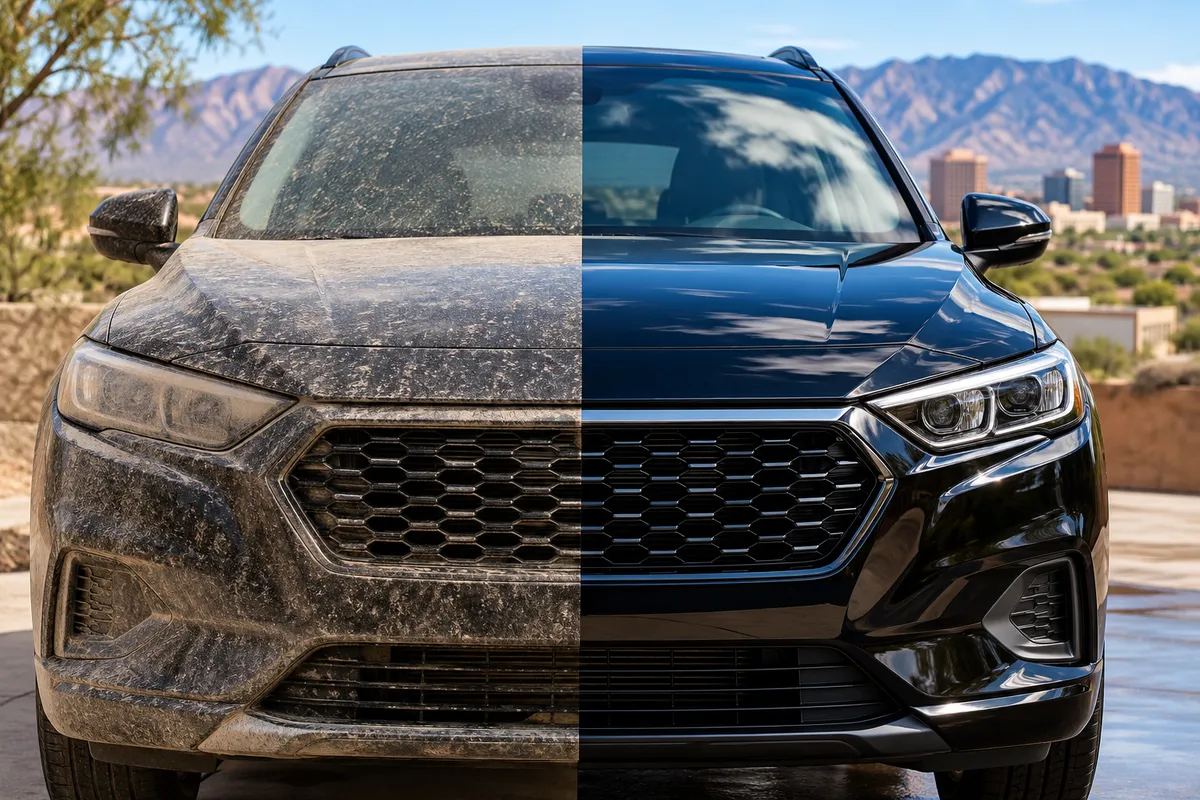
The Science of Car Wax: What It Really Does for Your Vehicle in Albuquerque, NM
The Science of Car Wax: What It Really Does for Your Vehicle in Albuquerque, NM
Why a proper wax isn't just about making your car shine. It's about protecting what you drive.
Your car can look perfectly clean and still be exposed to damage.
Every day in Albuquerque, NM, vehicles face intense sunshine, airborne dust, windblown sand, road grime, and sudden changes in weather. Over time, these conditions can take a toll on your vehicle's finish.
You might notice your paint losing its shine. Water no longer beads the way it used to. Dust seems to cling to every surface, and even after washing, your vehicle doesn't have that freshly detailed appearance.
That's where car wax comes in.
But what does wax actually do? Does it protect your paint, or is it simply a temporary cosmetic treatment?
At RND Auto Detailing and Glass Repair LLC, we believe understanding the science behind vehicle protection helps Albuquerque drivers make better decisions about caring for their investment.
Let's look at what really happens when you wax your car and why it matters in New Mexico's demanding climate.
What Does Car Wax Actually Do to Your Vehicle's Paint?

Car wax creates a thin, water-repellent protective layer over your vehicle's clear coat, helping reduce surface contamination while improving gloss and making routine cleaning easier.
Modern automotive paint typically consists of several layers:
Primer: Helps the paint adhere to the vehicle's prepared surface and supports corrosion protection.
Base coat: Provides your vehicle's color and visual appearance.
Clear coat: A transparent outer layer that provides gloss and helps protect the underlying color.
The clear coat is your paint's first line of defense against the environment. However, it isn't immune to ultraviolet radiation, chemical contamination, scratches, or gradual deterioration.
Car wax adds a temporary sacrificial layer over that clear coat.
Think of it as an additional protective barrier. It doesn't make your paint indestructible, but it helps reduce direct contact between certain contaminants and the painted surface.
For drivers in Albuquerque, where sunshine and airborne dust are part of everyday life, that additional protection can be valuable.
The Chemistry Behind Car Wax: How Does It Work?
Car wax works because of the chemical properties of the materials used in its formulation.
Many automotive wax products contain natural waxes, synthetic polymers, or combinations of protective ingredients designed to form a thin film on the vehicle's surface.
Natural Carnauba Wax
Carnauba wax comes from the leaves of a Brazilian palm tree.
It is valued in automotive detailing because it can produce a rich, glossy appearance and contributes to water repellency.
When properly formulated and applied, carnauba-based products can enhance the way light reflects from the paint, giving the finish a deeper, more polished appearance.
However, natural wax protection is temporary and gradually wears away through washing, weather exposure, and environmental conditions.
Synthetic Car Wax and Paint Sealants
Synthetic waxes and paint sealants use engineered ingredients, often including polymers, to provide gloss, water repellency, and environmental protection.
Depending on the formulation, synthetic products may offer longer-lasting protection than traditional natural waxes.
This makes them worth considering for Albuquerque drivers whose vehicles spend significant time outdoors.
Why Water Beads on a Waxed Car
One of the most noticeable effects of waxing is water beading.
This happens because many waxes create a hydrophobic, or water-repellent, surface.
Instead of spreading evenly across the paint, water tends to form rounded droplets.
The science involves surface energy and contact angle.
When the surface has lower affinity for water, droplets form a larger contact angle and bead more readily.
Some droplets roll off the vehicle, carrying loose particles with them.
However, water beading doesn't mean your vehicle is completely protected. Water can still evaporate and leave mineral deposits, especially in areas with hard water.
That's why proper washing and drying remain essential, even after waxing.
Why Car Wax Matters in Albuquerque's Harsh Climate
Albuquerque presents several environmental challenges that make regular paint protection particularly important.
1. Intense New Mexico Sunshine and UV Exposure
Albuquerque's elevation, sunny climate, and frequent clear skies contribute to significant ultraviolet exposure.
UV radiation can gradually affect automotive finishes, contributing to oxidation, fading, and clear-coat deterioration over time.
Some wax formulations contain ingredients intended to provide limited UV protection, but their effectiveness varies.
Car wax should not be considered a complete UV shield.
Instead, waxing is one part of a broader paint maintenance strategy that includes regular washing, appropriate protective products, and shaded parking whenever possible.
For drivers traveling through Uptown Albuquerque, Northeast Heights, or along Central Avenue, protecting vehicles from prolonged sun exposure is especially worthwhile.
2. Windblown Dust and Sand
Anyone who has lived in Albuquerque knows how quickly a clean vehicle can become covered in dust.
Wind can carry fine particles across parking lots, neighborhoods, and major roads.
When those particles settle on automotive paint, they can create problems during cleaning.
Dragging a dry towel across dusty paint may cause fine scratches and swirl marks.
A properly maintained wax layer can make contaminants easier to remove, reducing the amount of aggressive cleaning needed.
However, wax does not prevent scratches from abrasive particles.
The safest approach is to rinse away loose dirt before touching the paint.
3. Water Spots and Mineral Deposits
Albuquerque drivers also deal with mineral-rich water.
When water droplets evaporate on vehicle surfaces, dissolved minerals can remain behind.
These deposits may leave visible water spots, and prolonged exposure can sometimes contribute to more stubborn surface damage.
Wax can make water easier to remove, but it does not prevent mineral deposits from forming.
Regular drying after washing is still important.
For vehicles already affected by stubborn water spots, professional detailing and glass polishing may be necessary.
Does Car Wax Prevent Scratches and Paint Damage?
This is one of the most common misconceptions about automotive wax.
Car wax does not provide meaningful protection against rock chips, deep scratches, or physical impacts.
The protective film is extremely thin.
It can help reduce contamination and improve cleaning, but it cannot stop a rock from damaging your paint on I-40 or prevent a sharp object from scratching the clear coat.
Wax also cannot repair existing scratches.
Some products contain fillers that temporarily reduce the appearance of minor imperfections, but those imperfections remain in the finish.
For existing swirl marks and light scratches, professional paint correction may be a more appropriate solution.
At RND Auto Detailing and Glass Repair, our approach is based on identifying what the vehicle actually needs rather than recommending the same treatment for every situation.
Sometimes that means routine exterior detailing. Other times, paint correction or a longer-lasting protective coating may be worth considering.
Car Wax vs. Ceramic Coating: Which Is Better for Albuquerque Drivers?
Both car wax and ceramic coating can improve your vehicle's appearance and help protect its finish.
However, they are not interchangeable.
Car Wax: Practical Short-Term Protection
Traditional wax is often a good choice for drivers who want an affordable way to improve shine and maintain their paint.
Its advantages include:
Enhanced gloss and visual depth
Improved water repellency
Easier removal of some surface contaminants
Relatively straightforward maintenance
The primary limitation is durability.
Many traditional wax products last several weeks to a few months, depending on the product, weather exposure, washing habits, and vehicle storage.
Ceramic Coating: Longer-Term Paint Protection
Ceramic coatings use specialized chemical formulations that cure into a more durable protective layer on properly prepared surfaces.
Many automotive ceramic coatings are based on silicon-containing chemistry, although formulations differ between manufacturers.
Compared with traditional wax, professionally applied ceramic coatings can offer longer-lasting water repellency and resistance to certain environmental contaminants.
Depending on the coating and maintenance conditions, protection may last for years rather than months.
However, ceramic coatings are not scratch-proof, chip-proof, or maintenance-free.
Which Should You Choose?
If you regularly park in a garage, enjoy maintaining your vehicle, and want a traditional glossy finish, waxing may be sufficient.
If your vehicle spends long hours outside in Albuquerque's sun and dust, ceramic coating may offer a more durable protective option.
The best choice depends on your vehicle's condition, your budget, and how you use it.
At RND, we focus on precision detailing and practical recommendations that support long-term vehicle care.
How Often Should You Wax Your Car in Albuquerque?
For many Albuquerque drivers, waxing approximately every two to three months is a reasonable starting point when using a traditional automotive wax.
However, there is no universal schedule.
Your ideal waxing frequency depends on several factors:
Outdoor parking: Vehicles exposed to direct sunlight and weather may need more frequent protection.
Driving conditions: Dusty roads, highway travel, and environmental contamination can affect product longevity.
Washing frequency: Harsh chemicals and improper washing techniques may shorten wax durability.
Product formulation: Some synthetic sealants last longer than traditional waxes.
Vehicle storage: Garage-kept vehicles often experience less environmental exposure.
A useful maintenance habit is to observe how your paint behaves after washing.
If water repellency has noticeably decreased, dirt becomes harder to remove, or the finish looks dull, it may be time to inspect the paint and refresh its protection.
Water beading alone, however, is not a definitive measurement of remaining wax protection.
How to Properly Wax Your Vehicle: A Step-by-Step Guide
Waxing works best when the paint is clean, properly prepared, and free of significant contamination.
Step 1: Wash the Vehicle Thoroughly
Start with a quality automotive shampoo and clean washing materials.
Rinse away loose dust and debris before making contact with the paint.
Avoid household detergents that may be too aggressive for automotive finishes.
Step 2: Inspect the Paint
After washing, examine the surface for bonded contaminants, water spots, swirl marks, or scratches.
If the paint feels rough, additional decontamination may be appropriate before applying wax.
Step 3: Correct Paint Imperfections When Necessary
Wax improves gloss but does not permanently eliminate scratches.
If the paint has visible swirl marks or oxidation, professional paint correction may improve the final result.
Step 4: Apply the Wax Properly
Follow the product manufacturer's instructions.
Most waxes perform best when applied in thin, even layers to cool paint out of direct sunlight.
Using excessive product usually makes removal more difficult without improving protection.
Step 5: Remove Residue With Clean Microfiber Towels
Use clean, soft microfiber towels and gentle pressure.
Avoid using towels that have touched the ground or collected dirt.
Step 6: Maintain the Finish
Use safe washing techniques, remove contaminants promptly, and dry the vehicle after washing.
Consistent maintenance helps preserve both the appearance of the paint and the effectiveness of its protective treatment.
Why Professional Auto Detailing Makes a Difference
Applying wax may sound simple, but the quality of the preparation often determines the quality of the finished result.
Applying wax over dirty or contaminated paint can trap residue beneath the protective layer and leave the finish looking uneven.
Professional detailing considers the entire condition of the surface before protection is applied.
At RND Auto Detailing and Glass Repair LLC, our veteran-owned philosophy emphasizes discipline, attention to detail, and integrity.
We believe proper vehicle care should be based on what the vehicle needs, not how quickly a service can be completed.
Our services include exterior and interior auto detailing, ceramic coating, paint correction, headlight restoration, windshield repair and replacement, and glass polishing.
Whether you're commuting through Northeast Heights, traveling near Expo New Mexico, or driving along I-40 near Louisiana Boulevard, maintaining your vehicle's exterior helps preserve its appearance and makes ongoing care easier.
And while waxing is primarily about paint appearance and protection, our broader detailing and glass services also address visibility and vehicle safety.
Frequently Asked Questions About Car Wax in Albuquerque
Does car wax protect against the Albuquerque sun?
Some automotive waxes provide limited UV protection, depending on their formulation. Wax also helps maintain the appearance of the clear coat, but it cannot completely prevent sun-related paint damage.
Can car wax remove scratches?
No. Wax may temporarily conceal very fine imperfections, but it does not remove scratches. Paint correction is typically required to address suitable clear-coat defects.
Is it worth waxing an older vehicle?
Yes, provided the paint and clear coat are in suitable condition. Older vehicles can benefit from cleaning and protection, although severely damaged or failing clear coat may require different treatment.
Should I wax my car after every wash?
Usually not. Most traditional waxes last longer than a single wash. Follow the product's recommended maintenance schedule and evaluate the condition of the existing protection.
Can I wax my car during Albuquerque's summer heat?
Waxing in direct sunlight or on hot panels can make products difficult to apply and remove. Work in the shade on cool surfaces and follow the manufacturer's temperature recommendations.
Is ceramic coating better than wax for New Mexico weather?
Ceramic coating generally offers longer-lasting protection than traditional wax, making it attractive for vehicles frequently exposed to Albuquerque's sun and dust. However, both require proper maintenance.
Does waxing improve resale value?
Maintaining your vehicle's paint may help preserve its appearance, which can influence buyer impressions and vehicle condition assessments. Waxing alone does not guarantee a higher resale price.
Protect Your Vehicle With Veteran-Owned Precision Detailing in Albuquerque
Your vehicle faces a demanding environment every day.
The sun, dust, wind, and road conditions around Albuquerque can gradually affect its appearance.
Car wax is not a miracle product, and it cannot replace proper maintenance.
But when used correctly, it provides a valuable layer of protection that helps keep your paint cleaner, glossier, and easier to maintain.
At RND Auto Detailing and Glass Repair LLC, we believe vehicle care is about more than appearance.
It's about taking pride in what you drive, protecting your investment, and knowing your vehicle receives careful, dependable attention.
Our veteran-owned approach reflects the values we bring to every service: precision, discipline, integrity, and reliability.
Whether you need professional auto detailing, paint correction, ceramic coating, or windshield services, we're here to help you make informed decisions about your vehicle.
Ready to give your vehicle the attention it deserves?
Contact RND Auto Detailing and Glass Repair LLC to discuss your vehicle's condition and the protection options that make sense for your driving habits.
RND Auto Detailing and Glass Repair LLC
12910 Central Ave SE, Albuquerque, NM 87123
Phone: (505) 312-2455
Email:[email protected]
Veteran-owned. Precision-driven. Committed to Albuquerque.
If we've helped restore or protect your vehicle, we'd appreciate an honest Google review. Share your experience and let other Albuquerque drivers know how your ride looked after your visit.
Because a well-maintained vehicle isn't just about looking good today. It's about protecting what matters for the miles ahead.